|
The Art of Measuring
Low Resistance
by Tee Sheffer and Paul Lantz, Signametrics
Don’t heap all the blame for a wrong measurement on the DMM. There can be
several less obvious sources of the errors.
Testing assemblies and components usually includes checking the continuity of
connectors, wires, traces, and low-value resistive elements. Such applications
typically require both a DMM and a switching system.
Many users select a DMM and switching cards based only on the specifications of
the DMM and later are surprised to find that their measurements are an order of
magnitude less accurate than expected. Many users don’t recognize the error as a
system problem and conclude that the DMM is not meeting its specification.
Making accurate, stable, and repeatable resistance measurements is an art. There
is plenty of technology involved, but the art is an important part, especially
when you are measuring low resistance values.
To achieve your accuracy goal, you need to understand the error sources in your
application. It is important to start with a good DMM. But there are significant
error sources outside the DMM, some of which may not be obvious. Things may be
more complex than they seem, and some types of errors may be misinterpreted.
Limitations and Error Sources
Not all materials are created equal. Most connectors and test probes are made of
beryllium-copper or phosphor-bronze materials that closely match the
electromotive force (EMF) of copper. For this reason, they do not cause
significant thermally induced voltage errors.
However, relays and some other devices use nickel-iron alloys that do not match
the properties of copper. These can cause significant thermal EMF errors.
Thermal voltages are generated when there is a mismatch of materials combined
with a temperature difference.
This is the same principle that makes thermocouples work as temperature sensors.
If you expect readings that are accurate within a few milliohms, this is a big
issue. This error source also affects higher value resistance measurements but
to a lesser degree.
It is easy to overlook second-order specifications of a DMM, such as current
drive levels used for resistance measurement. These specs may be in small print
or missing, but they are important. For measuring low resistance, this spec
tells what you can expect from the DMM. The accuracy specs of the DMM don’t tell
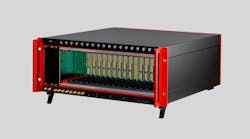
the whole story. For example, the Signametrics SMX2064 PXI DMM uses a
10-mA current source while most other DMMs are limited to 1 mA or less. Remember
Ohm’s Law: V = I × R means that 10 times the current produces 10 times the
voltage being sensed across the resistor. This larger signal is less susceptible
to external errors and noise and provides more signal to measure.
The larger signal almost always produces a more accurate measurement. It is
confusing to compare two DMMs having similar specifications in ohms if one has
10 times the current drive. The two are not the same. The one with the higher
current will perform better, especially in a system.
Good DMMs can measure signals down to a few microvolts. If you need to measure a
resistance down to a few milliohms, a 1-mA test current only produces 1 µV of
signal per 1 mΩ of resistance. In other words, you are operating right at the
resolution limit of the DMM.
With a 10-mA test current, there are 10 µV of signal per 1 mΩ of resistance. As
a result, a DMM that uses 10× as much current for this test will give about 10×
improvement in accuracy, stability, and repeatability for very low values.
If your test has serious throughput requirements and you need to make hundreds
of measurements per second, having a stronger signal combined with good noise
performance in the DMM makes a huge difference. Remember that the DMM’s accuracy
at higher speeds may be much more important than its best accuracy.
Two-Wire Ω
Everyone knows how easy it is to measure resistance using a two-wire connection.
However, for low resistance, a two-wire connection has disadvantages (Figure 1).
|

Figure 1. Two-Wire Ω Ω |
Test leads frequently add >1 Ω of resistance, and your test probe may add
another 0.1 Ω of contact resistance to the measurement. These errors are
significant if you are measuring 20 Ω.
You can eliminate most of the test-lead errors from a two-wire connection by
shorting the leads and setting the Relative-Ohms control. This enables the DMM
to subtract the test-lead resistance from the readings that follow. This is a
very handy tool when you are doing manual testing, but it is less useful in an
automated test.
Four-Wire Ω
A four-wire connection is the standard method for measuring low resistance. It
eliminates the resistance of the test leads from the measurement. One pair of
leads carries the test current while the other pair of leads senses the voltage
across the resistor under test (Figure 2).
|

Figure 2. Four-Wire Ω |
The resistance of the current-carrying leads doesn’t matter because they are not
in the measurement path. The resistance of the sensing leads doesn’t matter
since they don’t carry any current.
A four-wire connection is not immune to thermal EMF errors caused by mismatched
materials. This usually is not important in manual testing situations, but it is
a major issue in automated systems where a relay switch is used.
Six-Wire Ω
What if the resistor you want to measure is in a circuit with other components
or resistors as in networks or on a loaded circuit board? Then you need a
six-wire guarded connection. This method makes it possible to measure resistance
in situations where it would be impossible otherwise. The SMX2064 DMM offers
this capability (Figure 3).
|

Figure 3. Six-Wire Guarded Ω In-Circuit Measurement |
A guard amplifier drives the junction of parallel components to a voltage level
that prevents any of the test current from leaking away from the resistor under
test. This is a standard method used by large ATE in-circuit test systems. With
the right DMM, you can implement it too.
Measuring Through a Switch Matrix
Many applications are for production test. In these cases, it is almost always
necessary to perform multiple tests and measure multiple points. You usually do
this by putting a switching card or a matrix ahead of the DMM. It is important
to note that the switching card can be a major source of error, particularly
when measuring low resistance.
Two-Wire With a Switching Card
How does adding a switching card affect your two-wire resistance measurements?
Two-wire resistance measurements certainly are attractive because you can fit
twice as many two-wire measurements onto a card as you can four-wire
measurements.
The economics are attractive. Perhaps you can put a short circuit on one of the
inputs to the switching card and measure that short to make a Relative-Ohms
measurement? This line of reasoning also might lead you to select the highest
density switching card possible.
However, there are reasons to be careful. A typical switching card does not have
the same resistance through all of its channels. Channel 0 may add 0.2 Ω to the
reading while Channel 20 may add 0.8 Ω. Consequently, measuring a short on one
does not give a good compensation for the other because they do not have the
same resistance.
Even if you could correct for the difference in channel-to-channel resistance,
relays typically have about 50 mΩ of contact resistance that will shift around
by 20 mΩ from one reading to the next. You might think that high-current relays
will have lower contact resistance, but it doesn’t work that way. High-current
relays usually have silver-plated contacts that give low resistance for currents
above 100 mA. Unfortunately, silver-plated contacts have a high and
unpredictable contact resistance for currents less than 50 mA.
Relays are made of nickel-iron materials, and they all have problems with
thermal EMFs. Frequently, this error source is not specified for high-density
switching cards. If not, the thermal voltages probably are around 100 µV. If
your DMM uses 10 mA to make this measurement, the switching card adds 10 mΩ of
error to the measurement. If your DMM uses only 1 mA, the switch will add 100 mΩ
of error to the measurement.
Keep in mind that this error voltage is made up of all of the closed relay
contacts connected to the sense lines of the DMM. The more complex the switching
system is, the higher the error will be.
Four-Wire With a Switching Card
Using a four-wire connection through your switching card takes care of the
resistance issues associated with the switching card. This accuracy improvement
happens at the expense of reduced channel density. However, it does not take
care of the thermal EMF problems that come with some switching cards (Figure 4).
|

Thermal Voltage Errors, Not Corrected
Figure 4. Four-Wire Ω Switching Card |
One way to reduce this error is to use a DMM with the Offset-Ohms function.
However, this method is very slow, it adds noise, and it is limited in its
capability to reduce the error. For best results, start with a high-quality
switching card that is specified for low thermal EMF error.
How big a problem are thermal EMF voltages in relay switches? A high-quality
switching card has about
10 µV while a typical one has >100 µV of thermal voltages. There are a few
instrumentation quality switches that exhibit 1µV or less.
Take a look at Figure 5 to see the effect. The yellow plots depict the specs of
two similar DMMs. One of the DMMs uses 1-mA excitation current while the other
uses 10 mA. There are some things to note:
|

Figure 5a. 1-mA Ohms Excitation
Figure 5b. 10-mA Ohms Excitation |
• Both DMMs have very similar specifications as shown by the yellow lines.
• As soon as you combine them with a relay card that has 10-µV offset, the
system error is considerably greater than the DMM spec. For the DMM with 10-mA
excitation, the system error is almost two times the DMM spec. For the DMM with
1-mA excitation, the system error is almost 10 times the DMM spec.
• If you combine the DMMs with a relay card that has 100-µV offset, the error
becomes huge. For the DMM with10-mA excitation, the system error is almost 10
times the DMM spec. For the DMM with 1-mA excitation, the system error is almost
100 times the DMM spec.
• The effect of the relay offset voltages overwhelms the DMM specifications in
both cases, but the DMM that uses 10-mA excitation current produces a system
spec between five and 10 times better than the DMM that uses 1-mA excitation.
Six-Wire With a Switching Card
A six-wire resistance connection works just fine with a switching card as long
as the card is organized to support it. Remember that a six-wire connection does
not increase the accuracy of your measurement unless other resistors in the
circuit need to be guarded. This is still the only way to guard-out parallel
resistors that otherwise would make the measurement impossible.
Examples
A manufacturer of semiconductor protection devices uses an SMX2064 on its
low-resistance four-wire range to accurately measure resistances around 20 Ω
before and after hitting the device with a high test voltage. Because the
SMX2064 can take an accurate measurement in as little as 1 ms, test throughput
is high.
A manufacturer of hybrid circuits uses an SMX2064 to measure resistance values
of less than 100 mΩ. In this case, speed is not an issue, but getting a useable
measurement is. Other DMMs that use only 1-mA excitation current did not qualify
to do the job.
Conclusion
If you need to measure low resistance values, you benefit by using a DMM that
has a 10-mA excitation current. A 1-mA source gives a much weaker signal to
measure and presents system-level problems, particularly if there are switching
cards involved. If you expect a stable, accurate result, you almost certainly
need to use a four-wire connection.
The accuracy spec of the DMM is important but not the whole story. Remember that
everything in the measurement path affects the accuracy of the measurement,
especially switching cards. Your best bet is to combine a DMM with good ohms
specifications and high test current and a switching card with a low thermal EMF
spec, preferably an instrumentation type.
About the Authors
Tee Sheffer is the president and founder of Signametrics. He received
undergraduate and graduate degrees in electrical engineering from the University
of Washington. From 1977 until 1990 when he founded Signametrics, Mr. Sheffer
was a senior staff engineer and project manager at Fluke. He holds 10 patents in
the area of test and measurement and has authored several technical articles.
e-mail: tee@signametrics.com
Paul Lantz, who has been involved with test and measurement since 1972, is vice
president of engineering at Signametrics. Before joining the company, Mr. Lantz
spent several years with Fluke in a number of engineering positions including
project manager and principal engineer. In addition to holding three test and
measurement-related patents, he has had several technical articles published and
received an M.S. in electrical engineering from New York University. e-mail:
paul@signametrics.com
Signametrics, 6073 50th Ave. NE, Seattle, WA 98115, 206-524-4074 |